
Annapurna Base Camp Trekking: Takeaways
Trekking is important for physical fitness, mental peace, understanding and loving nature and culture, and promoting local tourism. Annapurna Base Camp (ABC) is a popular trekking destination, which is located at Annuapurna Rural Municipality in Kaski district of Gandaki Province. Its importance increased with the recent visit of the United Nations General Secretary raising awareness about global warming and its impact.
While working at the Lumle Agricultural Research Centre from 1997 till the end of 2000, I did not have the opportunity to visit any part in the ABC route. In Mid-May 2022, I visited Ghandruk, which encouraged me to plan for a trek farther than Ghandruk. I succeeded ABC trekking in four days of trek from 21 to 24 October 2023 through Nayapool route. I traveled from Pokhara on 21 October and back to Pokhara on 24 October after completing the trek. Walking early in the morning at around 7 am till 5 pm in the evening was common.
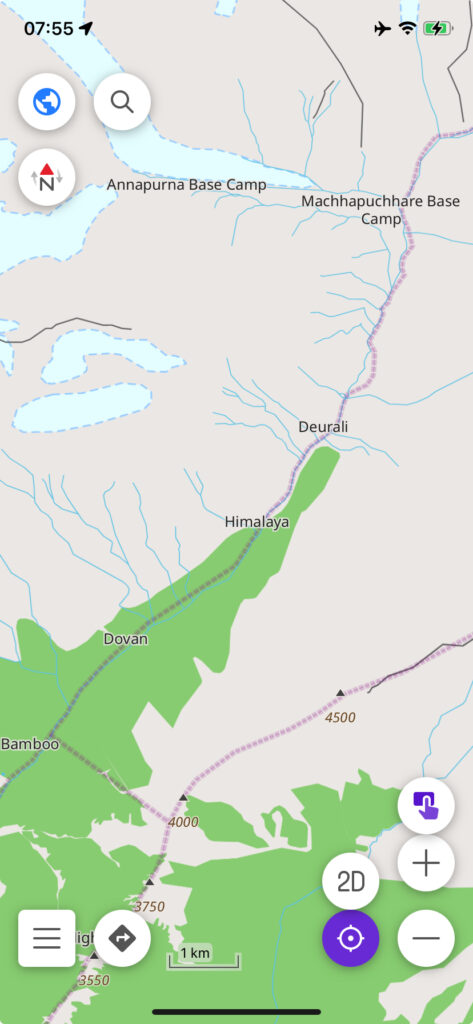
It was the Dashain festive season in Nepal with almost a week long public holiday. Thus, I decided to go for the ABC. I downloaded a route map to help locate the places. I consulted with my brother who had been to the ABC in a team of trekkers. He assured that the route was clear with directions and notes to follow and there would be lots of trekkers on the way. Thus, I traveled alone without any companion and trekking guide.
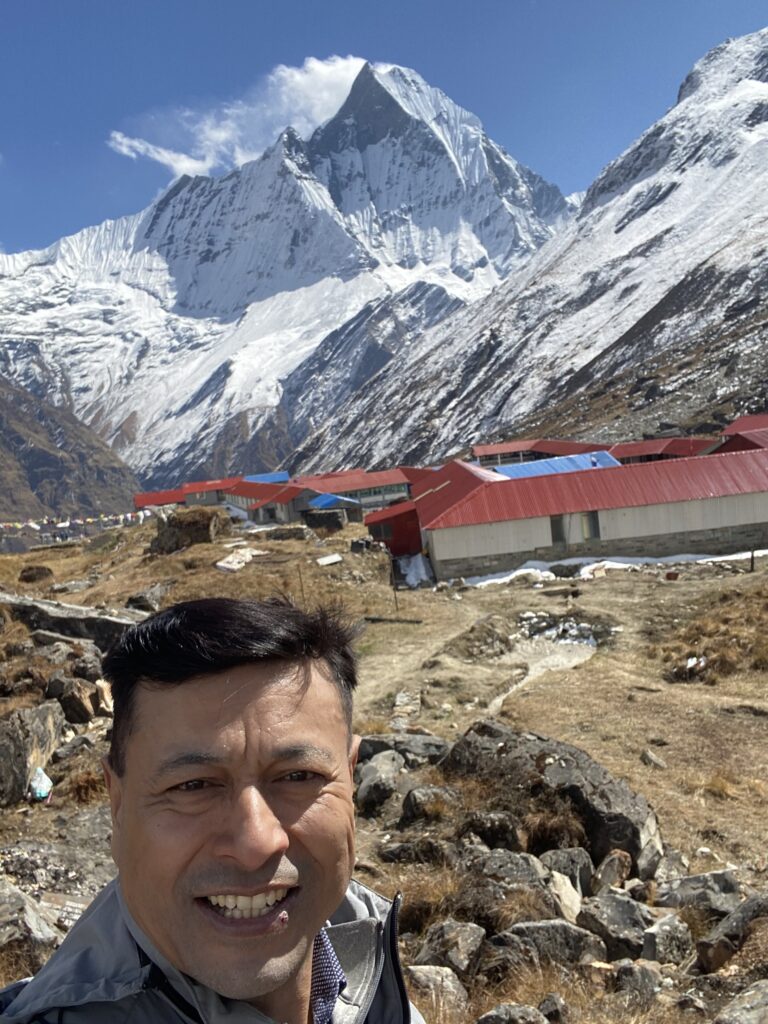
I gained some experiences which I tried to explain in this article as takeaways. I hope that the readers will benefit from this article for planning and experiencing the individual and budget trekking.
Travel Route and Modes of Travel: The route map below is posted at Nayapul at the point where jeeps and buses are left for Ghandruk or Jhinu (New bridge point). Nayapul is located at 40 kms on the way at Pokhara Baglung highway (Bhupi Sherchan Marg). The altitude of the trekking route varies from one thousand to more than four thousand meters above sea level (masl). Nayapul is located at one thousand plus masl and ABC at 42 hundred masl.
There are nine stoppages for the trekkers to stay overnight: 1) Ghandruk (towards west north from Nayapul) or Jhinukhola (towards east north), 2) Chhomrong, 3) Sinuwa, 4) Bamboo, 5) Dovan, 6) Himalaya, 7) Deurali, 8) Machhapuchhre Base Camp, and 9) ABC.
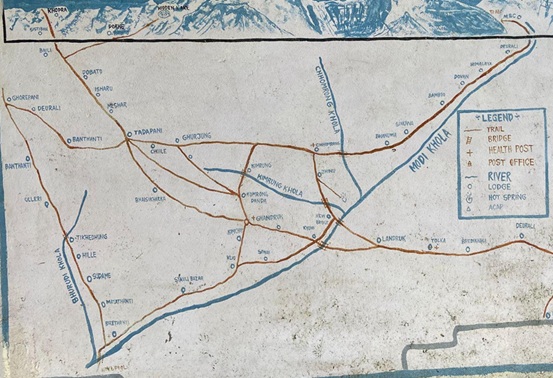
Mostly, I walked through the foot trails and in some parts at the beginning and end of the journey I traveled in a bus and a jeep. I traveled by bus from Nayapool to Ghandruk. I reached Ghandruk at around 11:30 am in a one and half hour drive. A local bus charged me Nepalese Rupees (NRs.) Three hundred. On the way back, I traveled from Jhinukhola to Nayapool and to Pokhara in a jeep. The jeep charged me NRs. 1500 for single occupancy.
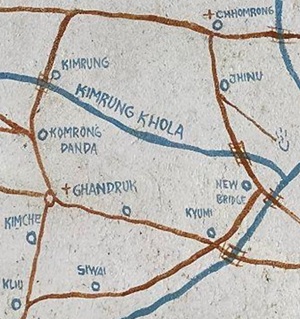
Jhinu-Chhomrong is the common trekking route: I started my trekking journey from Ghandruk at noon to reach Komrong Danda, Kimrung Khola and then to Chhomrong. I choose that route thinking to avoid a steep cliff uphill in the route Jhinu-Chhomrong. But, the route Ghandruk-Chhomrong that I followed was not common as I did not find any outsiders traveling in the four hours route to Chhomrong. Trekking alone through steep cliff jungle after crossing Kimrung Khola was risky. I thought my choice of Ghandruk-Chhoroung route for lonely travelers was not the right option.
On the way back, I followed the route Chhomrong-Jhinu. I found many travelers ascending a steep cliff up from Jhinu. It indicated that Jhinu-Chhomrong was the common route.
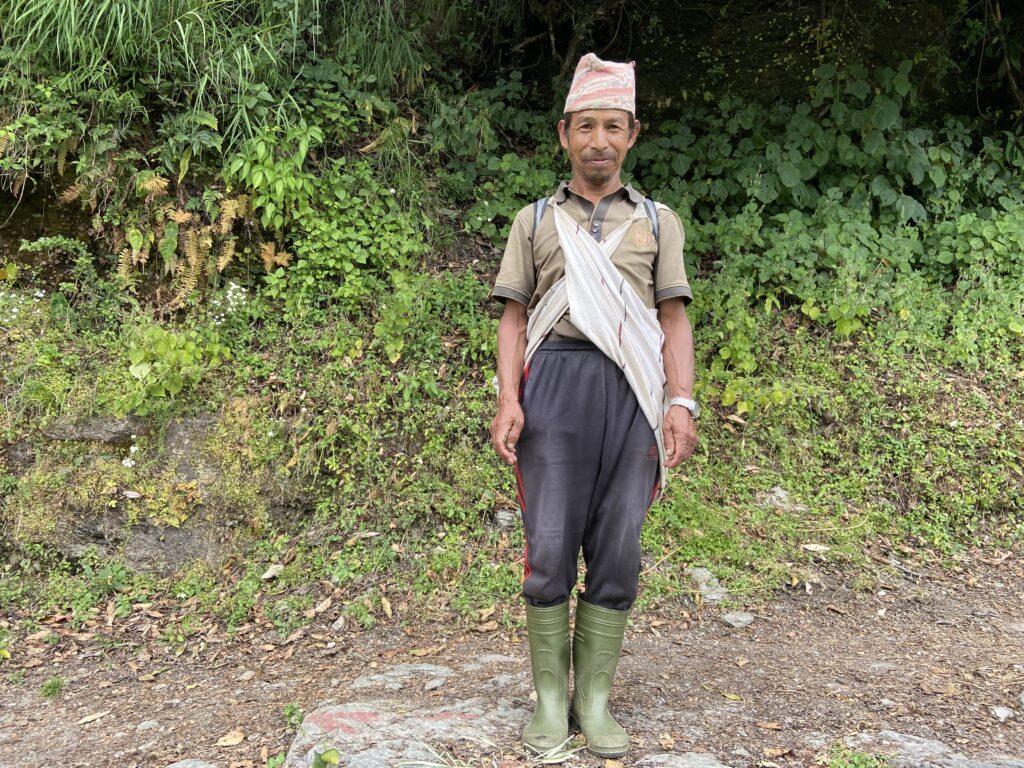
Don’t hesitate to ask local people for information or help: Local people are knowledgeable of the local context. While ascending through the jungle from Kimrung Khola towards Chhomrong, I met a person collecting fodder for livestock (right photo). I asked him to accompany me on the jungle route uphill with the condition to pay him some money. He agreed and accompanied to the confusing point from where his right hand route goes to Tadhapani towards Ghorepani (red mark on the stone in the photo), and lefthand route goes to Chhomrong.
Walk in a group: I remember an African proverb, “If you want to go fast go alone, if you want to go far go together”. A trip alone has the flexibility of not having to agree with or wait for someone to complete the trip fast. There is no harm in planning a trip alone. But, while trekking it’s better to go together with other people along the route to avoid loneliness and risks. Going far may require the support of others. During my trip, at many instances I was alone on the trails. I felt that if I happened to see or encounter wild animals or I fell down, I would have to face hard times. The trekking route passes mostly through the jungles. Locals say that bears particularly with small children are dangerous. Recently, a bear attacked a person and badly damaged the trekker’s face.
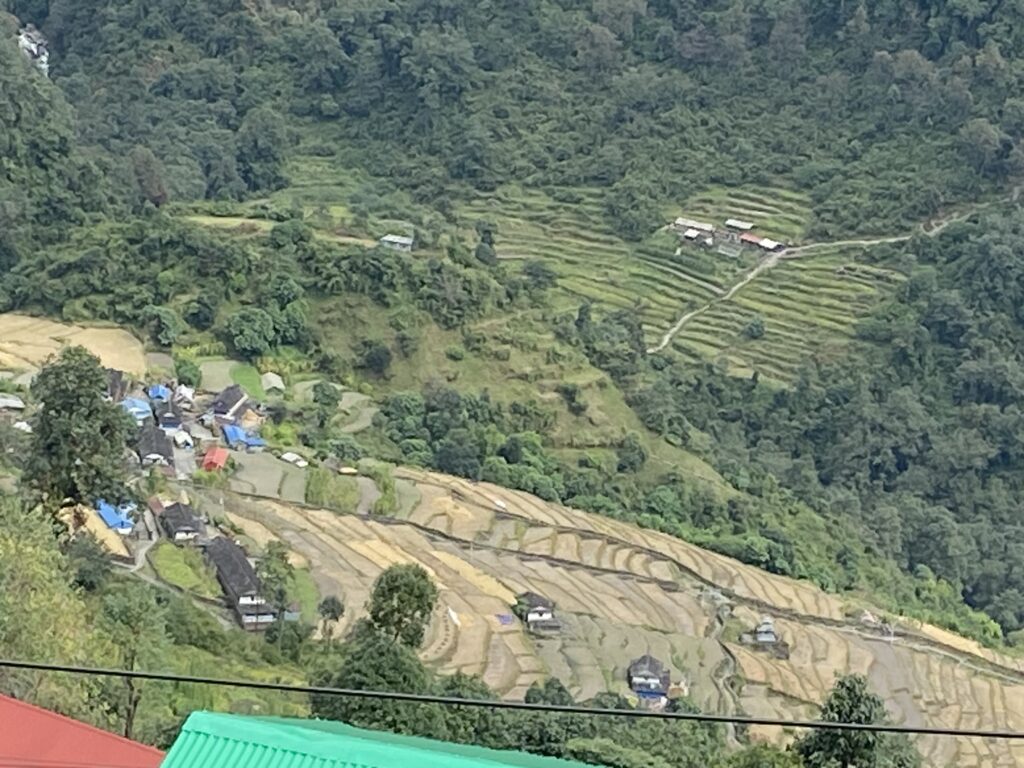
Chhomrong rice variety: Chhomrong is a red coloured rice variety, which is named after Chhomrong village (photo: field after Chhomrong paddy harvest). I had the opportunity to taste Chhorong rice at Traditional Home Stay at Chhomrong. Rice was tasty, and sticky. This thick rice lasts longer than thin rice so that one does not get hungry soon. Pakhribas Agricultural Centre and International Centre for Integrated Mountain Development, MFS Series No. 36, 1994 report on Options for Sustainable Mountain Agriculture Reported that Chhomroung rice variety was released for high hills with the potential of producing four metric tons per hectare.
October-November could be the best season: This period is a transition from warm to cold season. I saw snowfall only at the ABC (photo: snow on the ground at 11:30 am). There was neither snow nor rainwater in the trails, making the journey convenient for walking. Wet or snow filled trails make the trek slippery.
Places of natural beauty: On the way, there are several places of natural beauty that keep on energizing the trekkers. One of them is a place from Himalay to Deurali where multiple springs fall down to feed Modi khola. The closer the mountain views, the closer the trekkers feel reaching to the final destination. After crossing Machhapuchhre Base Camp (MBC) I felt that my last destination, the ABC, was only a few yards ahead, although I walked for an hour from MBC to ABC. On the way after MBC, wetland was one point of attraction, not only for trekkers, also could be for wild animals reaching for drinking water.
Mobile power backup: In most parts mobile networks are available for calls and internet access. Mobile battery power is drained for call, browsing the internet and taking photos. Mobile battery power is drained fast due to cold weather. Charging a mobile in the hotels costs NRs. Two hundred to Three hundred rupees per day. Mobile power backup will help maintain battery power.
Offline mobile map application: “OsmAnd Maps” is an application to download maps of a country. Not all places have access to the internet. Offline maps will help locate the trail and places in absence of the internet. An Indian guy from Calcutta in West Bengal explained how he used an OsmAnd offline map to locate trails while trekking from Ghandruk to Ghodepani.
Limit the backpack to 6-8 kgs: Uphill climbing with a load is difficult. Limiting the number of clothes (a pair of socks, underpants, vests, trousers and windcheaters) reduces the load. I wore a tracksuit and took two windcheaters for warmth and to avoid load. The load includes dry fruits, snacks and drinking water also.
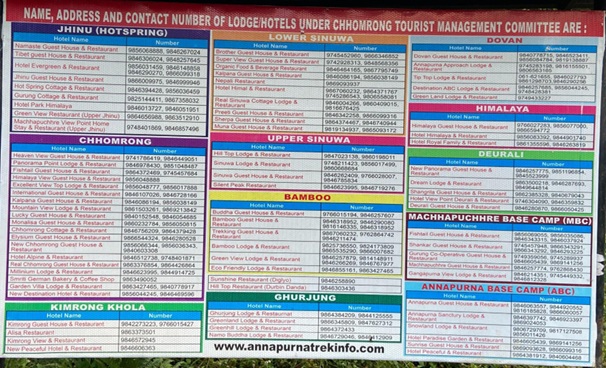
Rooms are available for sharing: Couple of hotels are available at every station. Both single rooms and rooms on a sharing basis are available. Owners charge NRs. Two to three hundred for a bed in the common room. Advanced booking is fine, but searching rooms as you arrive is also common. The National Trust for Nature Conservation has posted at Chhomrong the list of hotels in the region (below photo). There may be some homestays also, but not very common as in Ghandruk. I asked the local whether there were some homestays. They referred one and I stayed at the Traditional Homestay owned by Kajiman Gurung (mobile number 9842764861).
Drink lot: Drinking water is a must to replenish water in our body due to loss of perspiration. It is better to drink a cup of water every half an hour of walking. A bottle of drinking water costs NRs. Two hundred. Carrying two bottlers of drinking water per person is advisable. As one bottle is finished, replace it with another so that at least a sealed bottle is with the trekker all times.
Carry Juice and Dry Fruits: Drinking juice is good to energize body. It is costlier with the remoteness due to increasing transportation cost. A can of coke costs NRs. Four Hundred Rupees and a Fruite juice costs NRs. Two hundred. A cup of tea costs NRs Two Hundred.
Age and sex are not the barriers: I saw a number of Nepali national to foreigner family groups of members ranging from around 10 to more than 60 years age comprising boys and girls to grandmother and grandfather age groups. “I’m taking my daughter for trekking to give an exposure to the nature, as today’s children are mostly limited to gadgets [mobile and internet]”, a father of a teenage daughter shares while climbing uphill at Sano Sinhwa.
Goldstar is a best trekking boot: If one has already using good conditioned sport shoes, it will be fine to use. Otherwise, Goldstar brand trekking boots are a good option. It costs within NRs. Three Thousand only. High cost branded boots may not be a good option for a budget trekker.
A stick is a helpful tool: A stick is helpful while trekking whether ascending or descending. I got one wooden heavy stick from the bush and used it throughout the journey. It could be useful for other purposes also such as chasing wild animals if sighted. I wanted to take it home as it had become a good inanimate friend, but due to inconvenience, I left it in Pokhara. I really missed it while traveling back home on a bus. I see many people using a single or double machine made of sticks.
A pair of gloves is always helpful: Gloves protect us from cold and injuries while walking. Close to ABC, I saw a gentleman having difficulty holding the mobile phone due to the cold in the morning.
Sun Cream and First aid kit: Walking during day time could tan the skin. Thus, using sun cream saved my skin colour and texture. First aid kits will be a useful material to carry to treat instantly in case of minor injuries and illness.
Stones from ABC: Stones are non-perishable goods one can carry back from the trek. These can be cleaned and kept as memories with dates and places written with the markers. These can be gifted to relatives and friends as memories.
On the whole, ABC trekking is an important trekking destination to get an exposure to natural beauties, and to energize mentally and physically within a limited time and budget.